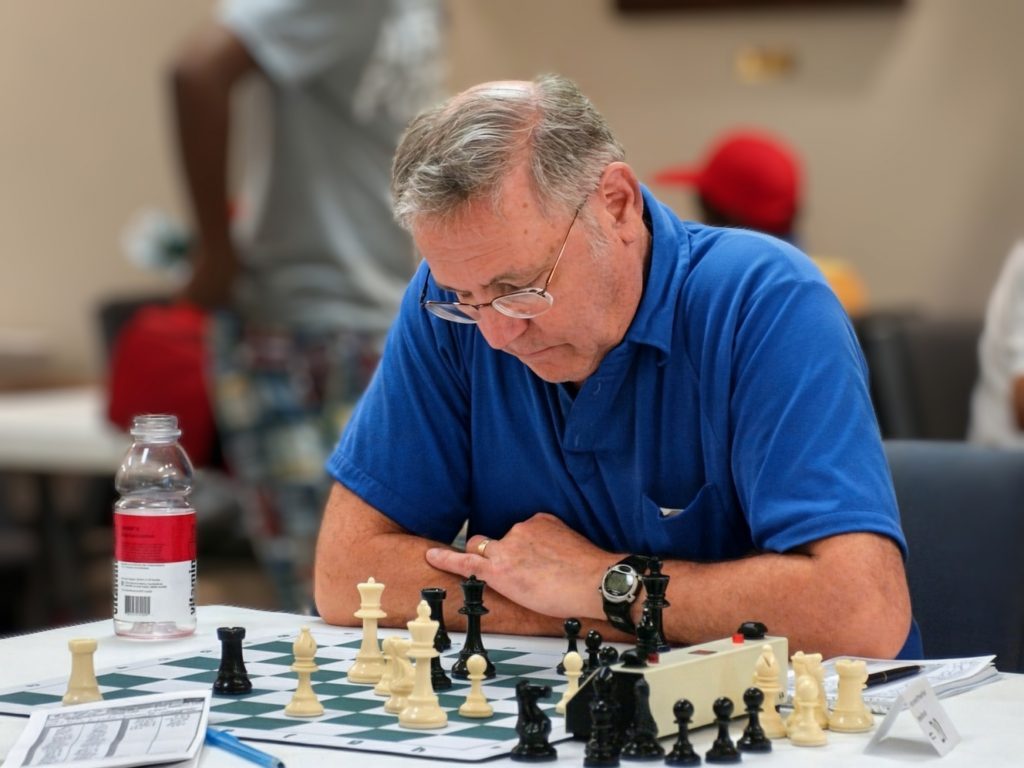
Cliff Batezel competing at the 2009 Pitman Open. Photo courtesy of Henry Feltman.
For more than six decades, Cliff has been part of the chess community as a player, teacher, student of the game, and leader. From teaching himself the rules as a child to serving as Woodbury Chess Club president for 22 years, chess has remained a constant throughout his life.
His introduction to the game came at an early age.
“When I was 10 years old, I heard something on the radio about a chess game going on, and I asked my mother to buy me a chess set. She took me to Camden, and we bought my first chess set. I taught myself from the directions how to play, but I couldn’t figure out how the bishop moved. I played a game with somebody, and they moved the bishop, and I go, ‘Aha, now I understand.’ But I taught myself how to play.”
Cliff continued playing while serving in the military and at local YMCAs, but there was a period when chess took a back seat. That changed in 1972.
“When I got out of the military, I stopped playing. I said, ‘You know what, I’m grown up now, I got to move on’ and then Bobby Fischer was playing the World Championship… 1972 was the beginning of me starting seriously playing chess.”
Once he committed himself to improving, he immersed himself in the game.
“I was reading some chess books. Reuben Fine had some good things out at the time… Chess the Easy Way by Reuben Fine is a really good book. And I was playing at four or five clubs at the same time.”
Chess soon became more than simply playing games. Cliff found himself teaching others, something that continues to bring him satisfaction decades later.
“I was teaching people even in the military. I taught people how to play. And to this day, they taught their kids, and I have met their kids, and those kids are still playing. And I taught all my grandkids how to play the game.”
Cliff’s commitment to teaching extended beyond family and fellow service members. He taught and coached middle school chess students for nine years and also spent three years teaching chess for Silver Knights.
His own competitive accomplishments included reaching a peak USCF rating of 1992. While he acknowledges that age has changed his playing strength, it has not changed his dedication to studying chess.
“To this day, seven days a week, I look over chess games. Six of those days, I do one at breakfast and one at lunch. And on Sunday, I only do one at lunch. I’m always looking over games, and I enjoy it enough that I continue to do that.”
When asked what has kept him involved with chess for so many years, Cliff’s answer extended far beyond the board.
“It’s been probably a lifesaver for me, if you think about the number of not only playing, but the number of people I’ve met, friends and acquaintances and phone calls and stuff. That is one of the things they tell you right now. Connection with other people is one of the things that can keep you healthy and live longer.”
That appreciation for people carried into his years as president of the Woodbury Chess Club. Cliff became president after being nominated by Ed Chong when Ed moved away for work.
“Ed Chong was the president before me… They wanted to take a vote in the club. He asked me to move out of the room while they talked, and when I came back in, they voted for me.”
Cliff had no idea it would turn into a 22 year thing. For those 22 years, Cliff and Henry made sure the club was ready every Tuesday night.
“Every Tuesday night, one way or the other, Henry and I mostly have been together, but if one of us couldn’t make it, somebody had to be here to open up. Somebody had to set things up and get going. So one of us for 22 years has been here on a Tuesday.”
Running a chess club inevitably brought challenges. Cliff recalled dealing with disruptive behavior when necessary, but always with the goal of treating people respectfully.
“We bring somebody in the kitchen. We’re not embarrassing them out there. We say, ‘Listen, here’s the rules. You can’t do that kind of thing.’ Sometimes we suspended people for a couple of months, and they’d come back and say, ‘You were right. I was wrong.'”
He also believes it’s important to keep competition in perspective.
“Sometimes people call, and Henry would be the first one to say to them, ‘Keep in mind, this is a game. This is not life or death.’ I mean, it’s a game, period… It’s fun. It’s interactive. It’s a connection with other people. All those things are good.”
When asked about his favorite memories of the club, Cliff didn’t point to tournament victories or ratings. Instead, he spoke about the people.
“Wow. You know, there’s been so many people that have been dedicated to come here. I can’t think of his first name….. Conte used to come in earlier and set the coffee up, set the boards up for us before anybody else. There’s several people who have been here for years and years and years. They were caring. They played and they weren’t necessarily real, real good, but they love the game and they interact with the people. “
Cliff remembered one longtime member handing him a business card, only for him to discover the member was a physician.
“One guy, we do a special tournament every year for, Dr. Wendell Waties. He’d been playing for like 20 years or more. One time he said, ‘let me give you that phone number.’ He took a card out of his wallet and on the other side it showed he’s a doctor. We never knew it. I mean, a doctor, physical doctor, an MD. When you sit down and play, you don’t care if somebody is the king of England or whatever you’re there to play the game. That’s what we do. Later you learn about their family or their kids or whatever’s going on or something else going on in life. It’s all been good for all of us.”
One event Cliff especially looks forward to each year is the annual February team tournament with Geoffrey, Tim McKeen, and Bill Trueman.
“One of my favorite things to do is the team tournament in February. It’s Geoffrey, myself, Tim McKeen, and Bill Trueman. We play a four-man team up there, and we love it. Love going. I can’t wait till February every year to enjoy that team camaraderie.”
The anticipation doesn’t end when the tournament is over.
“Tim McKeen, this is how crazy it is, when we finish that weekend, he’ll write me a text and say, ‘We only got 364 days,’ or whatever, before the next one.”
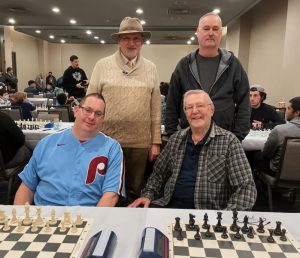
Cliff (front right) with teammates Geoffrey Herman (front left), Bill Trueman (back left), and Tim McKeen (back right) at the 2025 Amateur East Team Championship in Parsippany, New Jersey, an event Cliff says he looks forward to every February.
Away from the chessboard, Cliff worked in factories before earning a bachelor’s degree in psychology from LaSalle College while attending school at night. He later earned a master’s degree in counseling from Rowan University, eventually working in marriage and family counseling and as a crisis counselor in a school system.
His curiosity has never stopped.
“I read a lot. I like to learn everything. I’m curious about everything. I read all kinds of things—from the universe to whatever, anything. I’m reading a book right now on the Constitution of the United States.”
That same love of learning helped build an extraordinary chess library.
“Early on, you could get a chess book for a quarter… Now some are thirty or forty dollars. Because I collected them over the years, some of them you can’t buy anymore. If somebody says, ‘This is a great book,’ I have it and I can go get it and I can use it. I have over 1,500 chess books.”
When asked if he had actually read them all, Cliff laughed.
“No, no, no, no, no. But each book you buy, you think, ‘This is the one that’s going to make me a master.’ And then this one. Of course it never quite happens because there’s so much other stuff that has to do with playing and taking time. Besides, I had a family, I was working, I was going to college at night. You don’t have the time to put in to become a master.”
Listening to Cliff talk about chess, one theme comes through again and again. The game has given him opportunities to learn, to teach, to serve his club, and to build friendships that have lasted for decades. More than fifty years after he began playing competitively, his enthusiasm for chess remains just as evident as it was in 1972.